Solutions: Introducing the PH Strategies blog
by Andrew Brecher

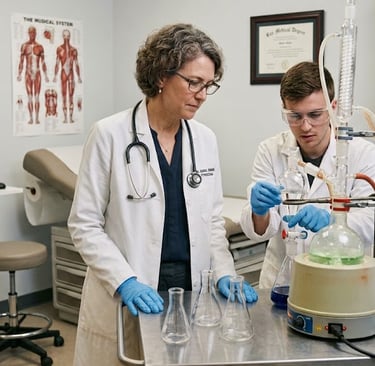
"Solutions" is a funny word. In common language, you probably think of a "solution" as the answer to a problem. In chemistry, a solution is something different: a substance that reflects a mixture of two or more inputs, creating an output that is often more useful than the individual components on their own.
I think about solutions a lot in the complex care space. Patients that have multiple health issues, or a health issue with multiple upstream drivers, can represent some of the most difficult challenges in healthcare. Treating one complex care patient is difficult enough. Having to manage groups of complex care patients can be a real problem.
That's where "solutions" come in. Think back to the chemistry example -- a mixture of more than one substance to create something now. Increasingly, complex care means mixing both traditional medical care with other interventions -- addressing health-related social needs, long-term supports and services, and caregivers with the support of community-based services. These collaborations -- or mixtures -- are crucial to solving population health challenges, just like the chemistry "solution" creates something that's more than just two substances thrown together.
Through this blog I plan explore evidence-based strategies and new developments in the population health space, hopefully in easy-to-digest language, with a focus on how healthcare and other entities can work together to support population health.
I am guided by the Triple Aim -- better health, and a better care experience, at lower costs. After twenty years in government service, funding and overseeing federal and state health programs, I have found that the most successful health interventions are often the least expensive. The doctor's office rather than the hospital. The HCBS provider rather than the nursing home. The community health worker rather than someone with lots of letters after their name. The app available 24/7 to everyone rather than the emergency room. And better care itself can lower costs overall, avoiding unnecessary institutionalizations, preventing disease progression, and maintaining function.
It's a miracle, isn't it, that better quality is often associated with lower costs? You don't see that in other industries, where low cost is usually low quality. And yet health care is one of the most expensive things in the entire country -- both for household and for government budgets. How do we take advantage of these lower cost, higher quality opportunities? How can everyone work together to make health, and healthcare, more effective and more affordable? Where we can we find the best solutions -- in both senses of the word?
That's my journey. I hope you'll join me.
Sign up for my LinkedIn newsletter (link forthcoming) to receive regular updates, and to share comments and feedback with me and with other readers.